Lost in a Seoul Subway Station? Here is the One Phrase You Need
Lost in a Seoul subway station? Learn the single most important Korean phrase to find your correct exit and navigate the transit system like a local!
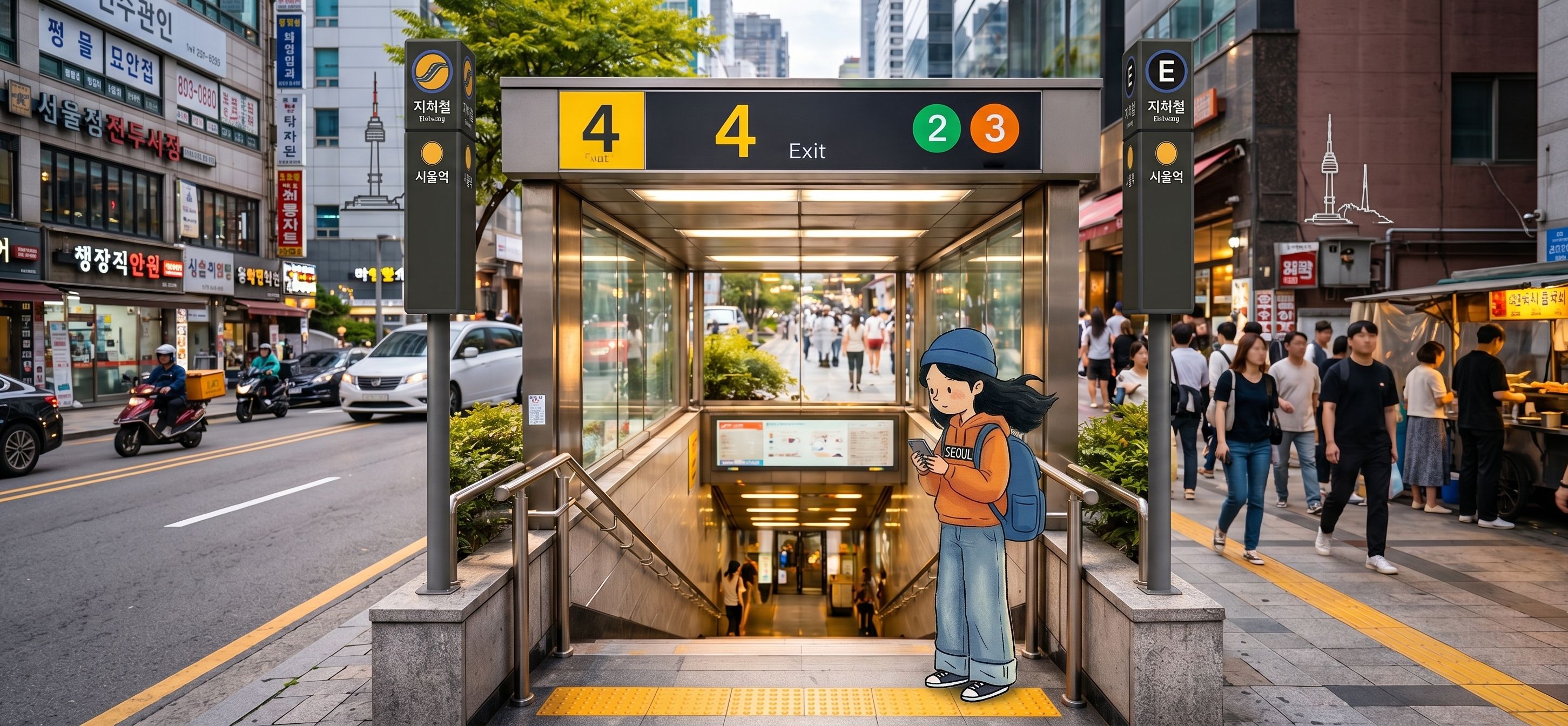
How to navigate the transit system like a local—and the essential sentence to get you there.
Seoul has a highly efficient and well-connected subway system that can take you almost anywhere in the city. However, for a newcomer, it can still feel a bit overwhelming.
With multiple lines intersecting at massive hubs like Seoul Station or Hongik University Station, finding your way isn't just about getting on the right train—it's about finding the right exit.
Some stations have more than ten exits, and coming out of the wrong one can leave you far from your actual destination.
When you need to confirm your direction, there is one practical phrase that will instantly get you back on track.
The Key Phrase: 몇 번 출구로 나가야 돼요?
Instead of wandering around, the fastest way to find your way is to ask a nearby commuter or station staff member this question:
"몇 번 출구로 나가야 돼요?"
(myeot beon chul-gu-ro na-ga-ya dwae-yo?)
"Which exit do I have to take?"
Let's break down this useful sentence piece by piece:
- 몇 번 (myeot beon): Which number
- 출구로 (chul-gu-ro): Toward the exit
- 나가야 돼요? (na-ga-ya dwae-yo?): Do I have to go out?
If you want to know the general direction instead of a specific exit number, you can simply ask, "어디로 나가야 돼요?" (eo-di-ro na-ga-ya dwae-yo? / Which way do I go out?).
What Will Locals Say Back? Decoding the Answers
When you ask for help, you will typically hear one of these two polite and common structures:
- "1번 출구로 나가세요." (Il-beon chul-gu-ro na-ga-se-yo.) → "Go out through Exit 1."
- "1번 출구로 나가면 돼요." (Il-beon chul-gu-ro na-ga-myeon dwae-yo.) → "You can just take Exit 1."
If they are unfamiliar with the area, they might politely reply:
- "죄송해요. 저도 잘 몰라요." (joe-song-hae-yo. jeo-do jal mol-la-yo.) → "I’m sorry. I don’t really know either."
K-Culture Bite: The Secret to Efficiency
Many commuters in Korea use mobile transit apps to check exactly which subway car and door number will place them closest to their transfer stairwell or final exit. By downloading local transit apps, you can navigate the stations smoothly and move around the city much more efficiently.
Essential Korean Vocabulary: Subway Navigation
| Korean | Romanization | Meaning |
|---|---|---|
| 출구 | chul-gu | Exit |
| 지하철 | ji-ha-cheol | Subway |
| 어디 | eo-di | Where / Which way |
| 나가다 | na-ga-da | To go out / To exit |
| 죄송하다 | joe-song-ha-da | To be sorry |
Sample Dialogue:
A: "죄송한데, 몇 번 출구로 나가야 돼요?" (Excuse me, but which exit do I have to take?)
B: "1번 출구로 나가면 돼요." (You can just go out through Exit 1.)
Learn Korean: Everyday phrases, grammar, and pronunciation tips
The best way to learn Korean is by connecting phrases to real-world situations you will actually encounter.
At Seoul X on, our "Daily Life Korean" curriculum is designed to help you handle practical scenarios with ease. Instead of focusing solely on abstract grammar rules, you will master functional phrases, learn useful cultural context, and get real travel tips that you can use immediately.
Ready to navigate Korea with confidence? Book Your free trial lesson today and start your journey with current, relevant content that makes learning Korean feel completely natural!