Korean Convenience Store Guide: 1+1 Deals, Food, and What to Say Like a Local
The 편의점 (pyeon-eui-jeom) is a whole way of life in Korea. Here's how to actually use one — the food, the deals, the app tricks — plus the exact Korean to say at the register.
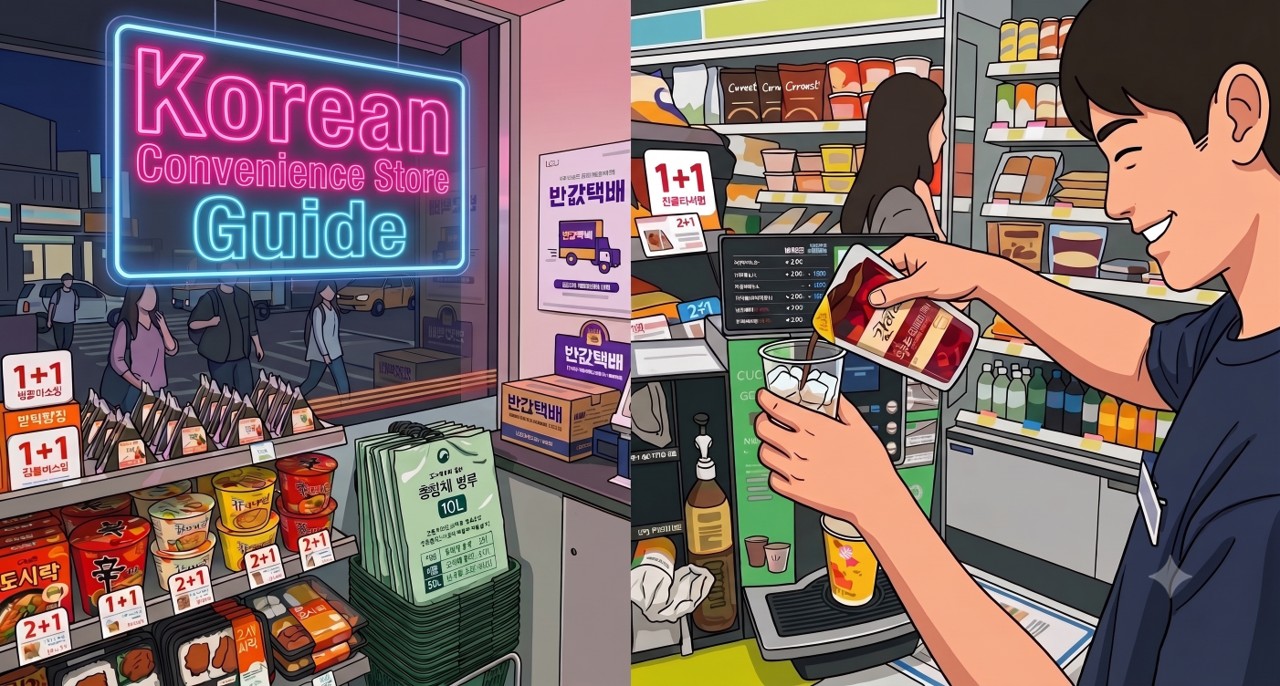
If you've spent even one day in Korea, you've seen them: a CU, a GS25, a 7-Eleven, or an Emart24 on practically every corner, sometimes two facing each other across the street. To a visitor they look like any other corner shop. They are not. The Korean 편의점 (pyeon-eui-jeom, convenience store) is a place where you can eat a full hot meal, brew café-style iced coffee, pay a bill, and buy your trash bags — often at 3 a.m.
Most first-timers use maybe 10% of what a 편의점 can do — and miss the little phrases that make it easy. Let's fix both. 🏪
🏪 First, the Big Four
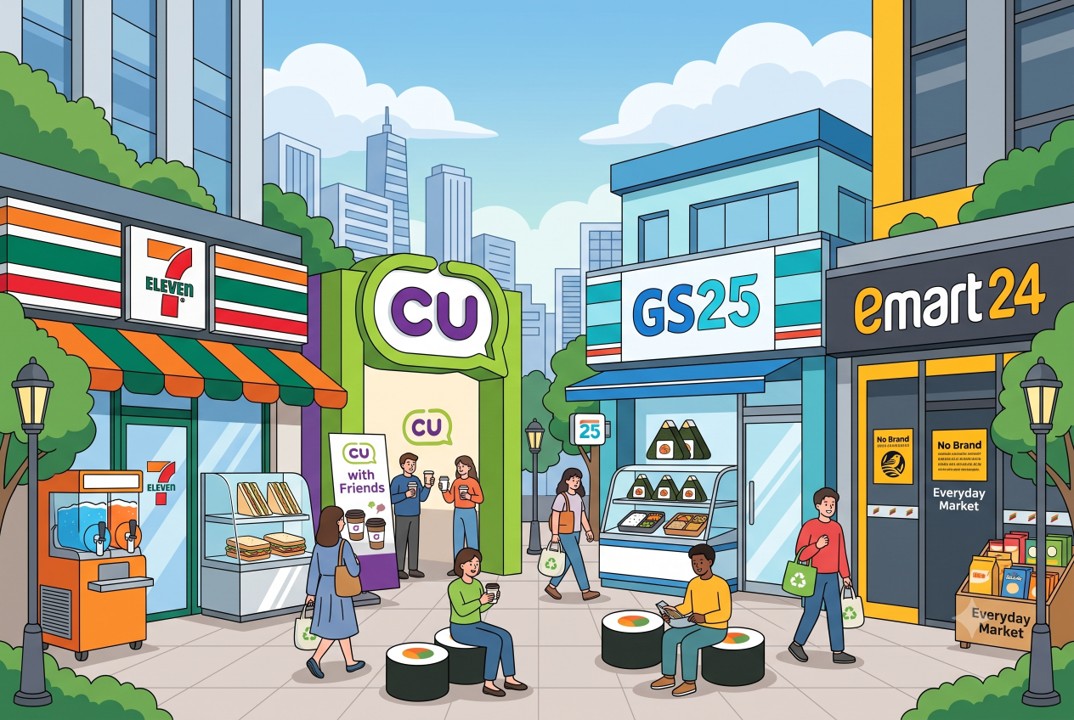
Korea has four major convenience store chains, and honestly, they're more alike than different: CU, GS25, 세븐일레븐 (7-Eleven), and 이마트24 (Emart24). Each has its own store-brand snacks and app, but the layout and the basics are the same everywhere. So don't stress about which one — just walk into whichever is closest.
What makes them special isn't the brand. It's everything they let you do inside.
☕ Coffee Three Ways — All Cheaper Than a Café Run
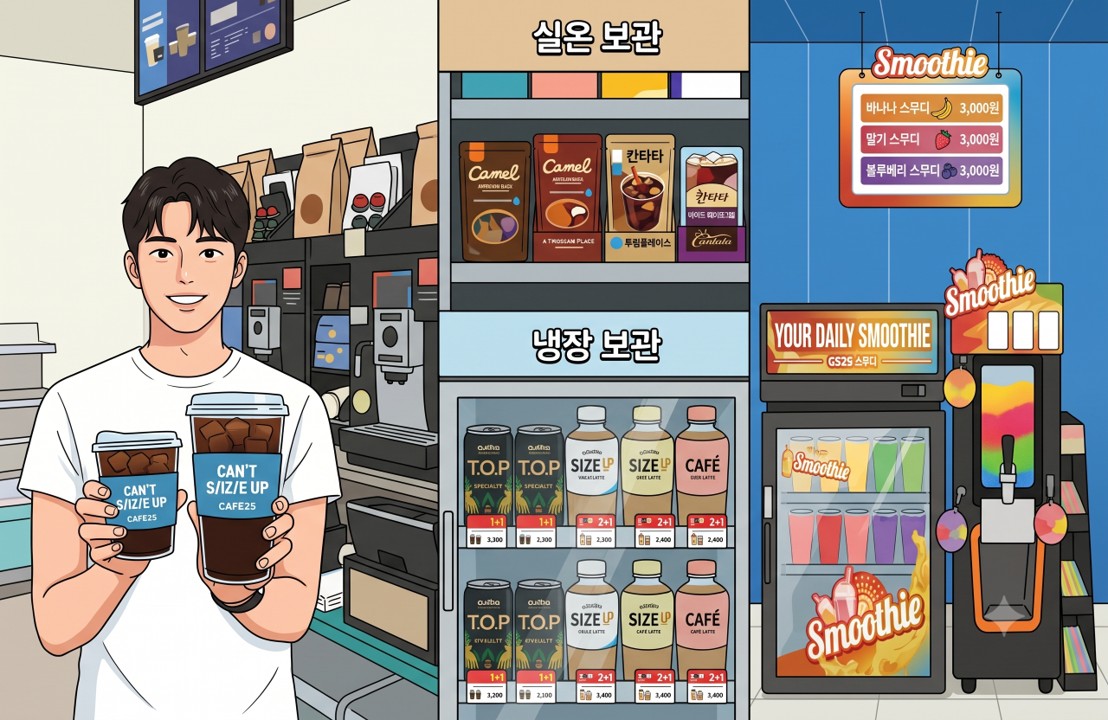
Coffee is one of the best deals in a Korean 편의점, and there are three different ways to get it. Korea already has famously cheap coffee chains where an iced americano runs about ₩1,500–2,000 — but a 편의점 coffee often matches that, or comes in even cheaper, without a detour to a café.
1. The ice-cup + pouch combo (the famous one). The trick every visitor falls for — and the key is that the ice cup isn't a drink, it's a tool. You'll find an 얼음컵 (eol-eum-keop, ice cup) — a cup of nothing but ice — sold by size near the counter. On a nearby shelf you'll see pouches of coffee, tea, and ade, kept at room temperature (실온 보관, sil-on bo-gwan) — not in a fridge, which surprises a lot of first-timers. Grab an ice cup, grab a pouch, pay for both, then pour the pouch over the ice. A pouch coffee plus an ice cup lands you an iced americano for well under ₩2,000. Match the cup size to the pouch or you'll overflow it — and locals love mixing two pouches, like coffee plus banana milk.
2. Ready-made from the fridge. Don't want to pour or mix? Head to the refrigerated section (냉장 보관, naeng-jang bo-gwan) and grab a coffee that's already made — bottled lattes, canned americanos, sweet milk coffees, all chilled and ready. No ice cup, no assembly, just pay and drink.
3. Fresh-brewed from the machine. The one that surprises people: most 편의점 now have a real machine that brews a fresh cup from actual beans, café-style. It's self-serve — buy a cup, press the button, and it grinds and brews right there. Around ₩1,500, genuinely close to café quality.
And many stores have a smoothie machine now too. The 편의점 quietly became a café.
🍜 Korean Convenience Store Food: It's Also a Restaurant
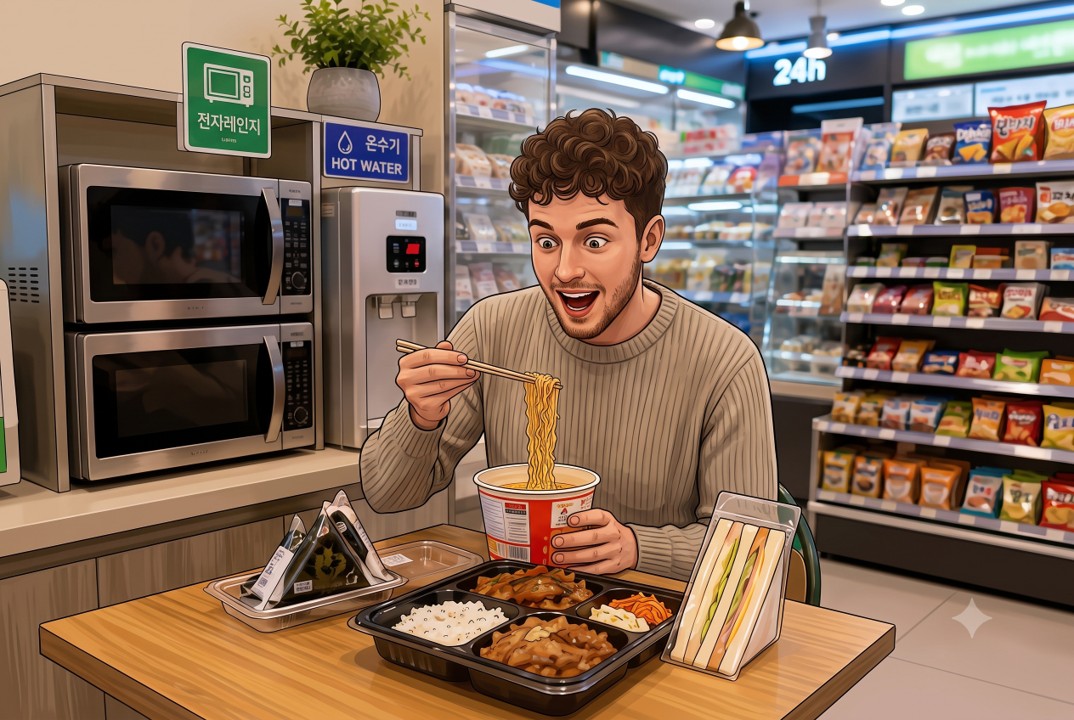
Here's the part that surprises people most: you can eat a real, hot meal here, standing up or at the little counter by the window.
The greatest hits:
- 삼각김밥 (sam-gak-gim-bap) — triangle rice balls wrapped in seaweed, with fillings like tuna-mayo or spicy pork. Cheap, filling, and there's a tiny art to opening the wrapper without tearing the seaweed.
- 컵라면 (keop-ra-myeon) — cup ramyeon, Korea's instant noodles. Every store has a hot water dispenser (뜨거운 물, tteu-geo-un mul) for exactly this. Fill it, wait a few minutes, done.
- 도시락 (do-si-rak) — a full boxed meal with rice and several sides. Pop it in the 전자레인지 (jeon-ja-re-in-ji, microwave) right there in the store.
Grab a triangle rice ball, microwave a boxed lunch, pour a cup ramyeon, and you've got a complete meal for a few dollars. They even sell fresh fruit and pre-cut snacks now.
One rule, though: clean up after yourself. Near the microwave you'll find a trash station with sorted bins. Leaving your mess on the counter is considered rude, so take the extra ten seconds.
💸 What Does "1+1" Mean in Korea? Cracking the 원플러스원 Code
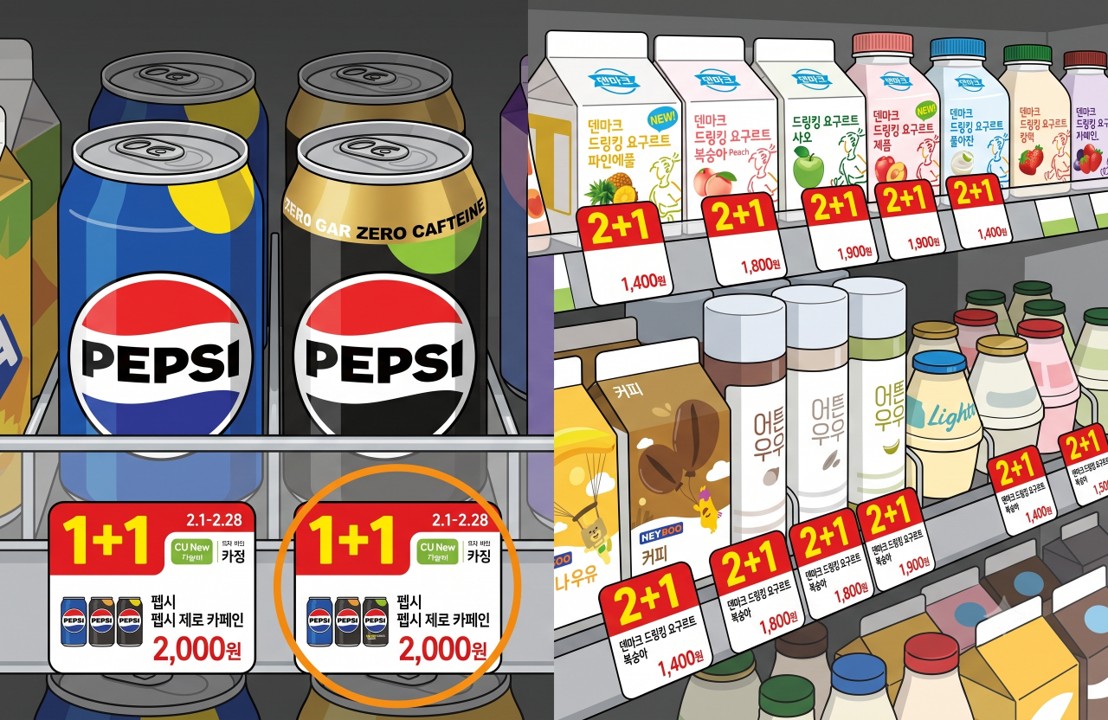
Now for the money-saving skill that took me a whole reel to explain — because it genuinely trips people up.
Walk through any 편의점 and you'll see two tags everywhere: 1+1 and 2+1.
- 원플러스원 (won-peul-leo-swon) — "one plus one." Buy one, get one free. Locals shorten it to 원쁠원 (won-ppeul-won) in speech.
- 투플러스원 (tu-peul-leo-swon) — "two plus one." Buy two, get the third free. Shortened to 투쁠원 (tu-ppeul-won).
Here's the hack most visitors miss. If a tag also says 교차 가능 (gyo-cha ga-neung, "mixing allowed"), you don't have to buy the exact same item twice. You can mix flavors — or even mix different products in the same promotion. Grab a peach drink and a grape one, or a coffee and a totally different snack, and still get the deal.
What this actually sounds like at the register: the moment that catches people off guard is when you buy a 1+1 item but only pick up one. The clerk may say "하나 더 가져오세요" (ha-na deo ga-jyeo-o-se-yo, "please grab one more") — that's your cue to go get the free one. Not sure if something's really a deal? Just ask: "이거 원쁠원이에요?" (i-geo won-ppeul-won-i-e-yo?, "Is this buy-one-get-one?") or "하나 무료예요?" (ha-na mu-ryo-ye-yo?, "Is one free?"). Two short phrases, and you'll never leave a free item behind again.
Two quick tips from experience:
- Check the unit price on the tag. Sometimes a plain markdown beats a 1+1, if the single item is already discounted.
- Confirm on the receipt. For 1+1 the second item should ring up as ₩0; for 2+1, the third should. Easy to check, easy to fix if it's wrong.
📱 The App Trick Locals Actually Use
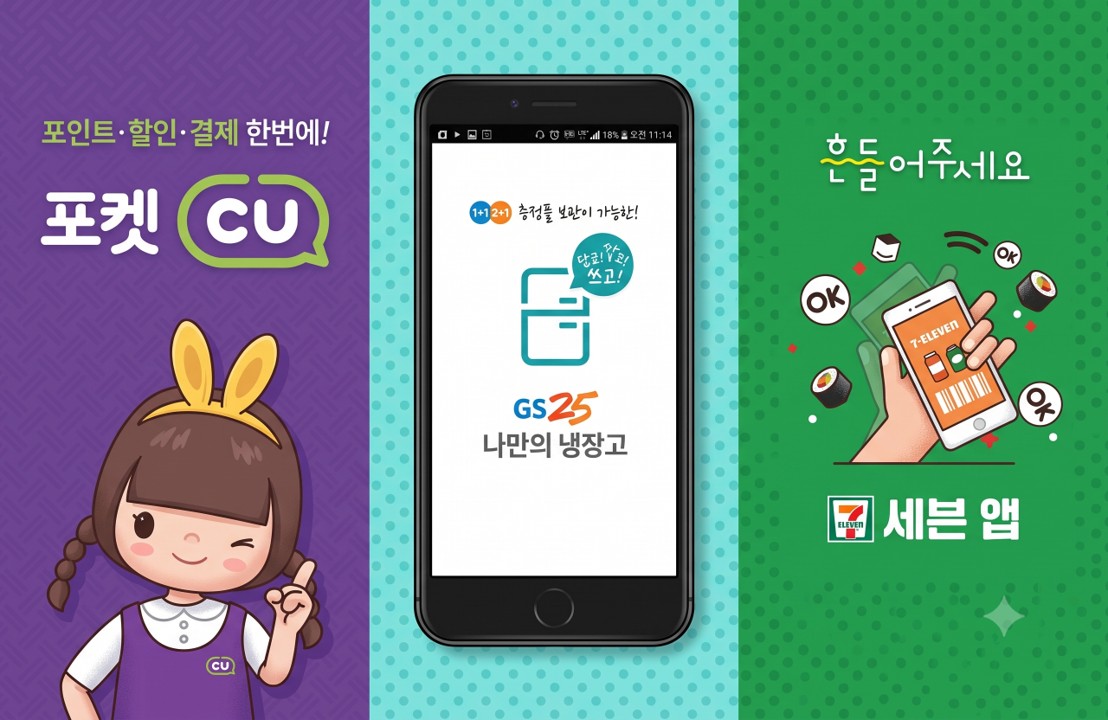
This is the level-up that separates tourists from residents.
Each chain has its own app, and they do far more than coupons. The best trick: when you buy a 1+1 or 2+1 deal, you don't have to carry the free item home right then. You can store it in the app and pick it up later — even at a different branch, on a different day.
The three biggest chains — GS25, CU, and 7-Eleven — all offer some version of this. You buy the deal, tap to store the extra item in the app, and scan a barcode to claim it whenever you like. So if you don't feel like lugging two big drinks around Seoul, bank the second one and pick it up when you're actually thirsty.
Scanning the app at checkout also stacks with in-store promotions for a little extra off.
🗑️ Living Here? The 편의점 Runs Your Trash
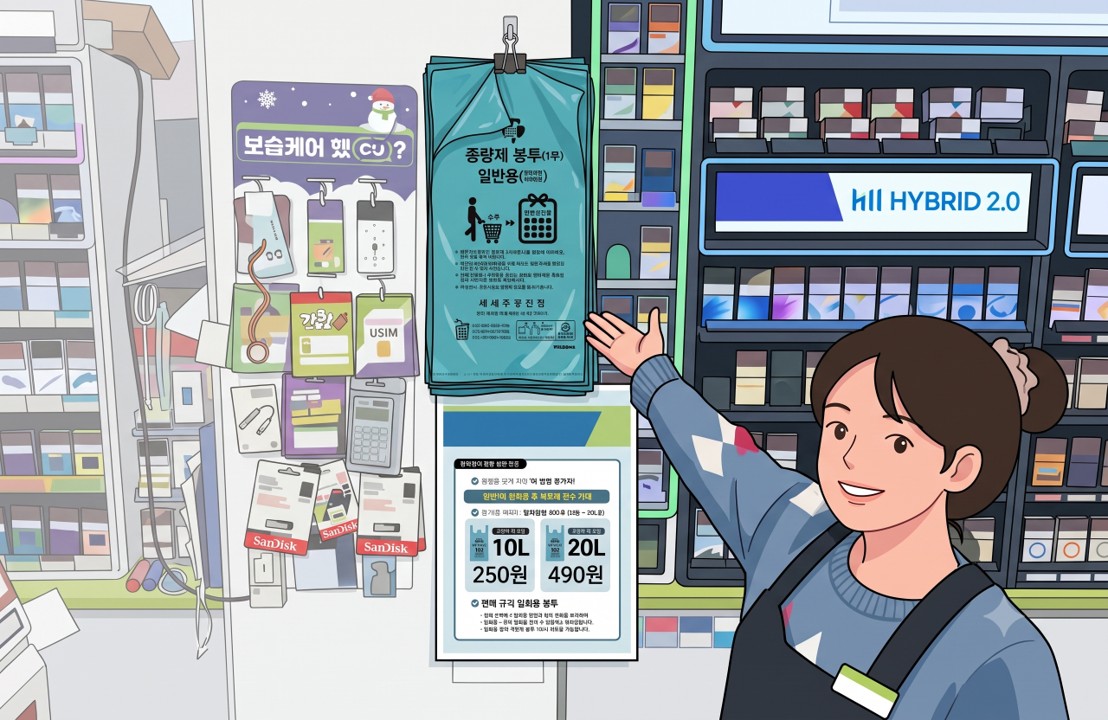
This one's for anyone staying longer than a trip — and it catches almost every newcomer off guard.
In Korea you can't just toss household trash in any old bag. You need an official 종량제 봉투 (jong-nyang-je bong-tu) — a government-approved "volume-rate garbage bag" — and the disposal fee is already baked into the price of the bag. And here's the catch that surprises everyone: these bags are district-specific. A bag from one district can't legally be used in another.
The good news? Your local 편의점 sells the correct bag for that exact district. So as long as you buy it near where you live, you're automatically fine. Just tell the clerk the size you need in 리터 (li-teo, liters) — 10L, 20L, and so on. Some stores also sell 음식물 쓰레기 봉투 (eum-sik-mul sseu-re-gi bong-tu), the separate bags for food waste.
A tip that saves travelers money: here's a small confusion worth clearing up. If you just ask for "a bag" to carry your snacks, the clerk might hand you — or suggest — a 종량제 봉투, since it's a trash bag they can always sell. But if you're a visitor just carrying purchases back to your hotel, you don't need a trash bag at all, and a 종량제 봉투 can actually cost more for the same size. Instead, ask for a regular bag — 일반 봉투 (il-ban bong-tu) — which stores sell for around ₩100. It's cheaper and does the job. Better yet, bring your own tote; Korea charges for bags to cut down on waste, so locals usually carry their own.
It's a small errand, but it's one of those quietly essential things that make daily life in Korea run smoothly.
📦 Sending a Package From a 편의점
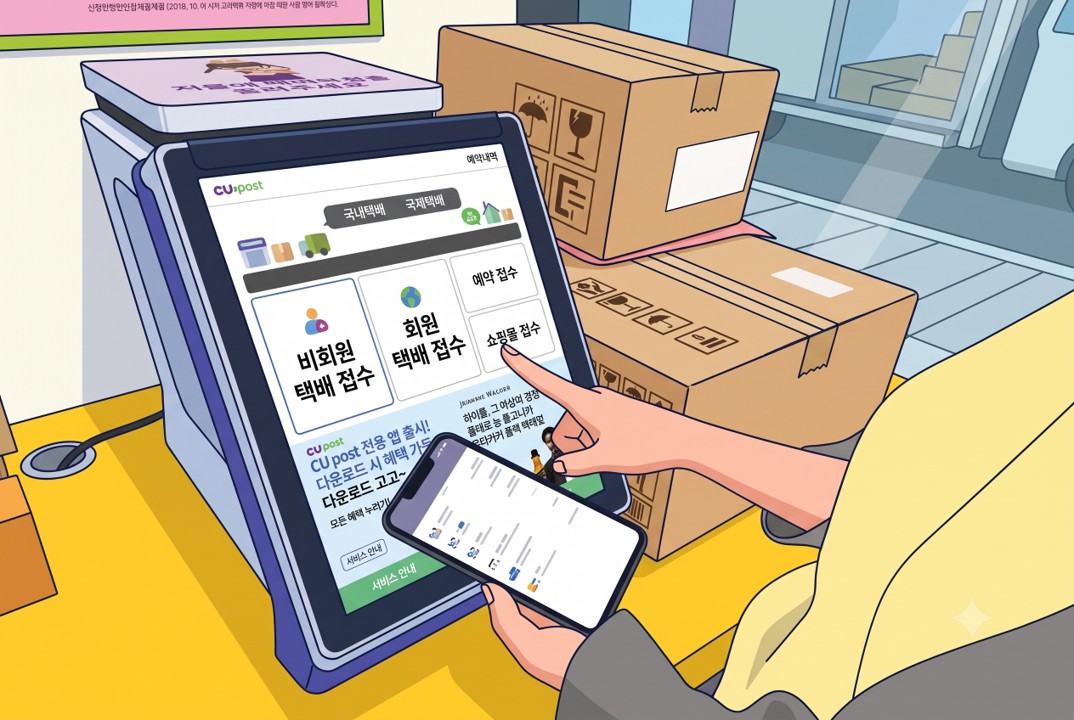
Here's another one that feels like a superpower once you know it: you can mail a package straight from a convenience store, no post office required.
Both CU and GS25 run a budget parcel service — CU 반값택배 (ban-gap-taek-bae, "half-price delivery") and GS25 반값택배 — that's noticeably cheaper than a regular courier. The catch is simple: instead of shipping to someone's home, the package travels store to store. You drop it at one 편의점, and the receiver picks it up at their nearest one. It takes a little longer than door-to-door, but it's cheap and easy.
Two things travelers and residents love about it:
- It's cheap. The store-to-store option runs well below standard courier rates, so it's the go-to for sending things you sold secondhand or small gifts across the country.
- Your address stays private. Because it ships to a store and not a home, the other person never sees your address — handy for online resale.
You can reserve it in the store's app (or even inside apps like Toss) and drop the parcel using the self-service machine, or just hand it to the clerk. If you want your package delivered all the way to a door instead, regular courier service is available at the counter too.
📝 Korean Vocabulary: Convenience Store Edition
Five words to get you through any 편의점 run:
| Korean | Romanization | Meaning |
|---|---|---|
| 편의점 | pyeon-eui-jeom | Convenience store |
| 얼음컵 | eol-eum-keop | Ice cup |
| 컵라면 | keop-ra-myeon | Cup ramen |
| 원쁠원 | won-ppeul-won | Buy one get one free (1+1) |
| 일반 봉투 / 종량제 봉투 | il-ban bong-tu / jong-nyang-je bong-tu | Regular bag / official trash bag |
Sample sentence: 얼음컵이랑 커피 주세요. 이거 원쁠원이에요?
(Eol-eum-keop-i-rang keo-pi ju-se-yo. I-geo won-ppeul-won-i-e-yo?)
"An ice cup and a coffee, please. Is this one buy-one-get-one?"
That's a real sentence you could use today — ordering your iced coffee and checking the deal in one breath.
❓ Korean Convenience Store FAQ
What does 1+1 mean at a Korean convenience store? It means "buy one, get one free" — you take two of the item and pay for one. 2+1 means buy two, get the third free. If the tag says 교차 가능 (gyo-cha ga-neung), you can even mix different flavors or products in the same deal.
Are Korean convenience stores open 24 hours? Most are, especially in cities like Seoul and Busan. A minority of branches keep shorter hours, but you'll rarely struggle to find a 24-hour CU, GS25, 7-Eleven, or Emart24 nearby.
Can I eat food inside a Korean convenience store? Yes. Most stores have a hot water dispenser for cup ramen, a microwave for boxed meals, and a small counter or seating area to eat at. Just clean up and sort your trash into the bins afterward — leaving a mess is considered rude.
Which convenience store is best — CU, GS25, or 7-Eleven? Overall quality is very similar across all four major chains. The differences are mostly in store-brand snacks and app perks, so the honest answer is: use whichever is closest.
Can foreigners send parcels from a Korean convenience store? Yes. CU and GS25 both offer a budget store-to-store delivery service. You can reserve it in the store app or hand your package to the clerk — no post office needed, and your home address stays private.
Do I need cash at a Korean convenience store? No. Card and mobile payment are accepted everywhere, and many stores have ATMs (some accept foreign cards) if you do need cash.
🎤 Learn Real Korean Like This — Free Trial
Convenience-store Korean is exactly the kind of language textbooks skip and everyday life demands. Ice cups, 1+1 tags, telling the clerk your trash-bag size — these are the small phrases that make Korea suddenly feel easy.
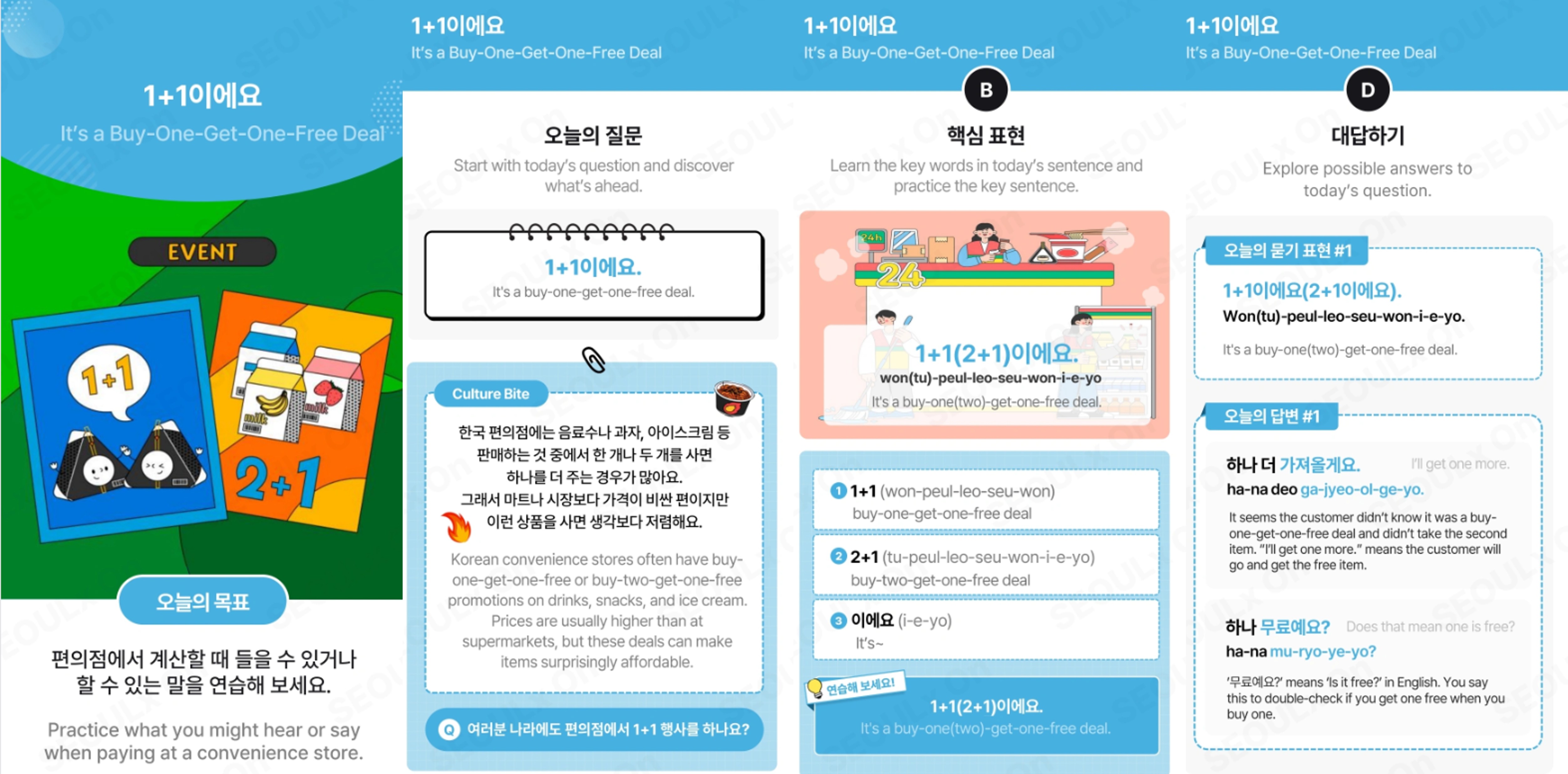
And this is exactly how we teach at Seoul X On. Take that "원쁠원" moment: in our lessons, we don't just hand you a word list — we walk you through the real scene at the register. What the clerk might say, how to ask "하나 무료예요?" (ha-na mu-ryo-ye-yo?, "Is one free?"), and how to answer "하나 더 가져올게요" (ha-na deo ga-jyeo-ol-ge-yo, "I'll grab one more") to actually claim your free item. Language you can use the second you walk out of class.
Our lessons connect Korean to real life — the food runs, the shortcuts, the words people actually say. Try a free trial lesson and start speaking the Korean you'll really use.