TOPIK I Listening Practice: Choose the Matching Statement & Explanation
Practice TOPIK I Listening with a free Korean conversation about food preferences. Learn to identify the matching statement and understand key expressions with clear English explanations.
Can you understand a Korean conversation about food preferences? In this free TOPIK I Listening practice from Seoul X On, you'll listen to a conversation about spicy food, choose the statement that matches the dialogue, and see exactly why it's right.
How can I practice TOPIK I listening online?
You can prepare for TOPIK online with Seoul X On, an online Korean language platform offering live 1:1 and group classes focused on TOPIK preparation. This free listening practice question helps you understand everyday Korean expressions about food preferences and identify information that matches a conversation.
1. Watch the TOPIK I Listening Practice Video
🎧 ▶ Watch the TOPIK I Listening Practice Video
Listen carefully and try to choose the statement that matches the conversation before checking the explanation!
2. TOPIK I Listening Practice Question
Question
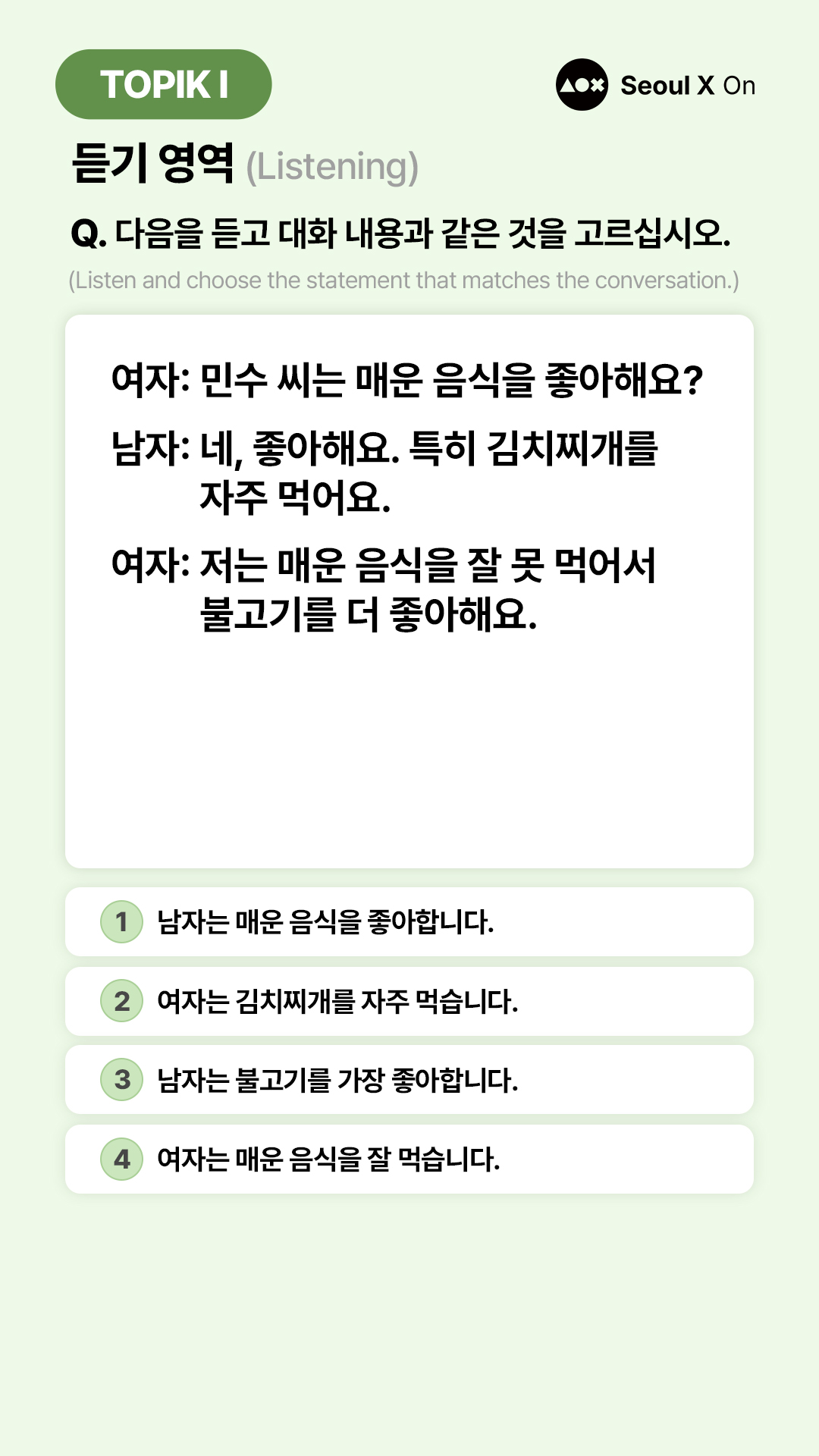
다음을 듣고 대화 내용과 같은 것을 고르십시오.
Listen and choose the statement that matches the conversation.
Audio Script
여자: 민수 씨는 매운 음식을 좋아해요?
남자: 네, 좋아해요. 특히 김치찌개를 자주 먹어요.
여자: 저는 매운 음식을 잘 못 먹어서 불고기를 더 좋아해요.
Woman: Minsu, do you like spicy food?
Man: Yes, I do. I especially eat kimchi stew quite often.
Woman: I can't handle spicy food very well, so I prefer bulgogi.
Answer Choices
① 남자는 매운 음식을 좋아합니다.
② 여자는 김치찌개를 자주 먹습니다.
③ 남자는 불고기를 가장 좋아합니다.
④ 여자는 매운 음식을 잘 먹습니다.
3. Correct Answer
✅ ① 남자는 매운 음식을 좋아합니다. (The man likes spicy food.)
The correct answer is ① because the man clearly says that he likes spicy food and often eats kimchi stew.
4. Detailed Explanation
The conversation is about two people's food preferences. The woman asks Minsu whether he likes spicy food, and he answers that he does. He also mentions that he often eats kimchi stew.
However, the woman says that she cannot handle spicy food very well, so she prefers bulgogi.
The key phrases are "네, 좋아해요" (Yes, I do), "김치찌개를 자주 먹어요" (I often eat kimchi stew), and "매운 음식을 잘 못 먹어서" (because I can't handle spicy food very well).
Let's compare what each person says:
Man: 네, 좋아해요. 특히 김치찌개를 자주 먹어요.
Yes, I do. I especially eat kimchi stew quite often.
Woman: 저는 매운 음식을 잘 못 먹어서 불고기를 더 좋아해요.
I can't handle spicy food very well, so I prefer bulgogi.
The man likes spicy food, while the woman prefers bulgogi because she has difficulty eating spicy dishes.
Therefore, ① is the correct answer because it accurately matches the man's statement in the conversation.
Let's look at the answer choices:
| Answer | Meaning | Explanation |
|---|---|---|
| ① 남자는 매운 음식을 좋아합니다. ✅ | The man likes spicy food. | Correct. The man directly says that he likes spicy food and often eats kimchi stew. |
| ② 여자는 김치찌개를 자주 먹습니다. | The woman often eats kimchi stew. | Incorrect. It is the man, not the woman, who says he often eats kimchi stew. |
| ③ 남자는 불고기를 가장 좋아합니다. | The man likes bulgogi the most. | Incorrect. The woman says she prefers bulgogi. The man does not say it is his favorite food. |
| ④ 여자는 매운 음식을 잘 먹습니다. | The woman can eat spicy food well. | Incorrect. The woman says she cannot handle spicy food very well. |
Remember: In TOPIK I Listening, pay attention to who says each statement. Expressions like "자주 먹어요" (I often eat), "더 좋아해요" (I prefer), and "잘 못 먹어요" (I can't eat it very well) can help you distinguish different people's food preferences and choose the correct answer.
Prepare for TOPIK Online with Seoul X On
Want to achieve your target TOPIK score with personalized guidance? Whether you prefer 1:1 or group lessons, we offer flexible options to help you reach your TOPIK goals.
① Live 1:1 Korean Classes
🎁 Start with a FREE 25-minute 1:1 trial lesson! After your trial, get a 50% OFF coupon.
② Live Group Korean Classes
📚 Special Offer: Buy 1, Get 1 FREE on Group Class Passes!
* Seoul X On is an online Korean language platform specializing in live TOPIK preparation classes, with both 1:1 and group lessons taught by professional Korean tutors. Start with a free trial lesson and prepare for TOPIK online.
* This is an original TOPIK-style practice question created by Seoul X On for educational purposes, not an official TOPIK past exam question.